
A Practical Methodological Primer on Sample Size Determination Using G*Power for Biomedical Research
Main Article Content
Keywords
Biomedical research, Effect size, G*Power, Power analysis, Sample size determination
Abstract
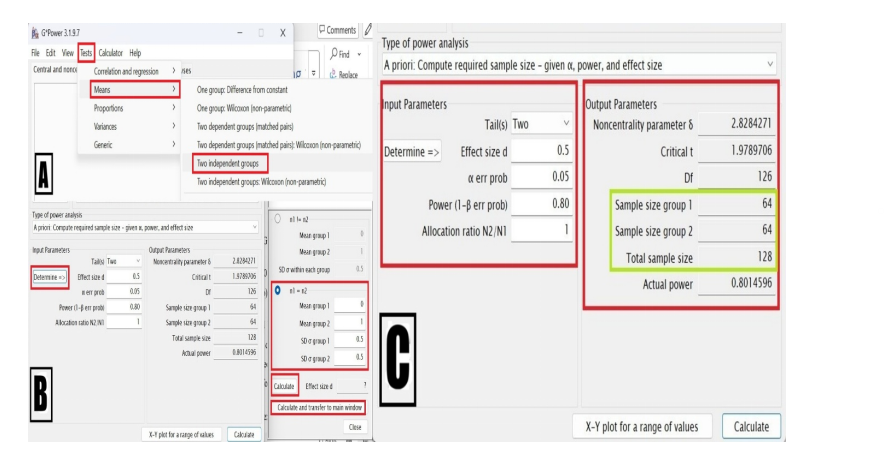
An appropriate sample size is essential to determine methodological steps that underpin the scientific validity, ethical integrity, and practical feasibility of biomedical and health research. Inadequate estimation may lead to underpowered studies or unnecessary resource use and participant exposure. This article provides a practical overview of statistical power analysis and sample size determination using the GPower software (version 3.1.9.7), which is a freely available tool for researchers. The Core statistical concepts, including hypothesis formulation, effect size estimation, significance level (α), statistical power (1−β), and their dynamic interrelationship, are outlined. The article further describes the GPower software ecosystem, its graphical user interface, supported statistical test families, and the distinct modes of power analysis. Step-by-step methods with realistic research scenarios demonstrate sample size calculation for commonly used statistical tests, including independent and paired t-tests, z-tests for proportions, one-way ANOVA, correlation analysis, and multiple linear regression. The article also highlights common pitfalls, limitations of G*Power, and advanced considerations in sample size estimation. This article aims to provide researchers with a structured framework for accurate sample size estimation, thereby enhancing study quality, reproducibility, and ethical responsibility in biomedical research.
References
In J, Kang H, Kim JH, Kim TK, Ahn EJ, Lee DK, et al. Tips for troublesome sample-size calculation. Korean J Anesthesiol. 2020;73(2):114–20.
Kang H. Sample size determination for repeated measures design using G*Power software. Anesth Pain Med. 2015;10:6–15.
Charan J, Kaur R, Bhardwaj P, Singh K, Ambwani SR, Misra S. Sample size calculation in medical research: a primer. Ann Natl Acad Med Sci (India). 2021;57:74–80.
Ko MJ, Lim CY. General considerations for sample size estimation in animal study. Korean J Anesthesiol. 2021;74(1):23–9.
Uttley J. Power analysis, sample size, and assessment of statistical assumptions—improving the evidential value of lighting research. Leukos. 2019;15(2-3):143–62.
Sharma SK, Mudgal SK, Thakur K, Gaur R. How to calculate sample size for observational and experimental nursing research studies? Natl J Physiol Pharm Pharmacol. 2020;10:1–8.
G*Power for sample size calculation: a guide for biomedical research [Internet]. Clyte Tech; [cited 2026 Feb 7]. Available from: [https://www.clyte.tech/post/g-power-for-sample-size-calculation-a-guide-for-biomedical-research](https://www.clyte.tech/post/g-power-for-sample-size-calculation-a-guide-for-biomedical-research)
How to determine sample size from G*Power [Internet]. Statistics Solutions; [cited 2026 Feb 7]. Available from: [https://www.statisticssolutions.com/how-to-determine-sample-size-from-gpower/](https://www.statisticssolutions.com/how-to-determine-sample-size-from-gpower/)
G*Power 3.1 manual [Internet]. 2023 Jun 1 [cited 2026 Feb 7]. Available from: [https://www.psychologie.hhu.de/fileadmin/redaktion/Fakultaeten/Mathematisch-Naturwissenschaftliche_Fakultaet/Psychologie/AAP/gpower/GPowerManual.pdf](https://www.psychologie.hhu.de/fileadmin/redaktion/Fakultaeten/Mathematisch-Naturwissenschaftliche_Fakultaet/Psychologie/AAP/gpower/GPowerManual.pdf)
Mudgal SK, Sharma SK, Gaur R, Patidar V, Rai AK, Varshney S. Sample size estimation in mixed methods research: balancing quantitative power and qualitative saturation. J Med Evid. 2026;7:e000036.
Cohen J. Statistical power analysis for the behavioral sciences. 2nd ed. Hillsdale (NJ): Lawrence Erlbaum Associates; 1988.
Article Sidebar
Article Details

This work is licensed under a Creative Commons Attribution-NonCommercial-ShareAlike 4.0 International License.
This is an open-access journal and articles are distributed under the terms of the Creative Commons Attribution Non-Commercial Share-Alike License 4.0. This licence allows users to download and share, remix, tweak and build upon the article for non-commercial purposes, so long as the original authorship is acknowledged and the new creations are licensed under identical terms.