
Reconsidering Routine Appendectomy in Ovarian Neoplasms: Implications for Diagnostic Staging
Main Article Content
Keywords
Reconsidering Routine Appendectomy , Ovarian Neoplasms, Implications for Diagnostic Staging
Abstract
Dear Editor,
Although the current International Federation of Gynecology and Obstetrics (FIGO) guidelines permit omitting appendectomy if the organ appears macroscopically normal,[1] this "visual-only" assessment lacks diagnostic validity in complex ovarian neoplasms. Preserving the appendix creates a “diagnostic vacuum”, resulting in under-staging and diagnostic uncertainty. Amidst the ongoing debate regarding appendectomy during gynaecological surgeries, the necessity of an appendectomy is often unknown until the final pathology report. [2,3] This letter highlights two scenarios where its absence almost hindered a definitive diagnosis.
Brief Background and Guidelines on the Current FIGO Recommendation on Cancer of the Ovary, Fallopian Tube, and Peritoneum: 2025 Update
In 2025, Renz et al. established the current global benchmark for staging ovarian, fallopian tube, and primary peritoneal cancers,[1] shifting towards selective surgery to minimize morbidity. Under these standards, appendectomy is indicated only for mucinous tumours, pseudomyxoma peritonei, or grossly abnormal appendix (defined by increased diameter, discoloration, or visible nodules). [4] This conservative posture relies on the statistically low rate of occult (microscopical) primary appendiceal tumours in a macroscopically normal appendix. [5]
However, a critical clinical gap exists where intra-operative frozen section is unavailable. Without real-time histology, surgeons are unable to definitively distinguish mucinous from non-mucinous ovarian epithelial tumours during primary surgery. Omitting appendectomy based on a “grossly normal” appearance frequently necessitates a second, avoidable surgery for diagnostic validation and staging if a mucinous morphology is later confirmed. Consequently, lack of immediate diagnostics transforms conservative surgery into a pathway of increased morbidity and delayed staging, often leaving the primary site as “undesignated” when definitive identification is impossible. [4,6,7]
Brief Background of the College of American Pathologists (CAP) Current Cancer Protocol (2024) for the Examination of Specimens from Patients with Primary Tumours of the Ovary, Fallopian Tube, or Peritoneum
The College of American Pathologists (CAP) Cancer Protocol (Version 1.5.0.0, June 2024), aligned with National Comprehensive Cancer Network [NCCN] guidelines, establishes the mandatory framework for pathological evaluation and synoptic reporting of ovarian, fallopian tube, and primary peritoneal neoplasms. Central to this protocol is the requirement that the “Primary Site” (Note C) be explicitly identified. [8] The guidelines acknowledge a significant historical shift in diagnostic practice, where the determination of the primary site was often based simply on the “dominant mass” encountered during surgery. However, the CAP protocol emphasizes that this historical reliance on organ size frequently resulted in extra-ovarian primary sites, such as those originating in the appendix or other gastrointestinal primaries, being mistakenly identified as primary ovarian or peritoneal neoplasms.
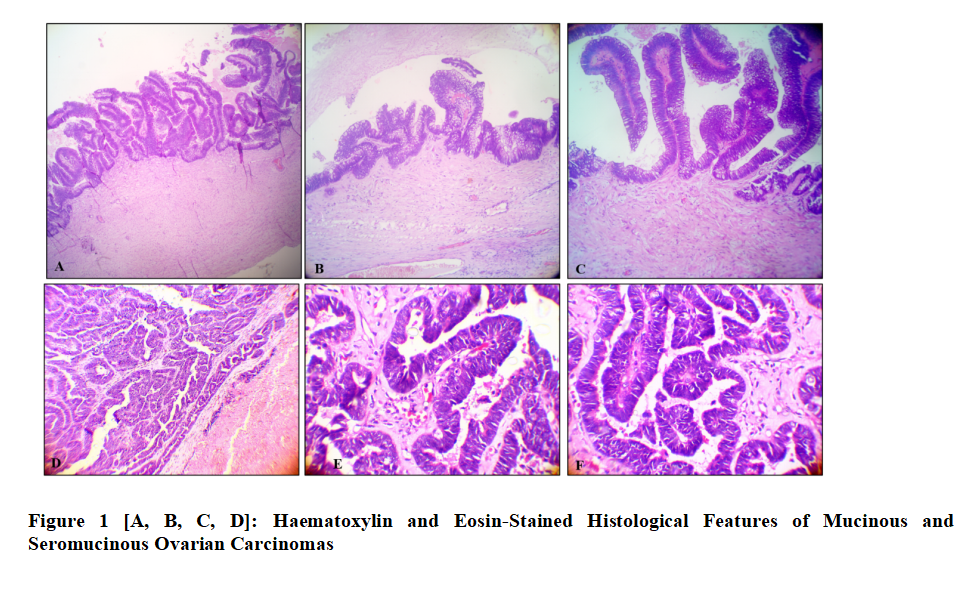
The most dangerous diagnostic hurdle in ovarian mucinous neoplasms is the “maturation phenomenon” or “mimicry study,” where metastatic low-grade appendiceal mucinous neoplasm (LAMN) to the ovary histologically mimics a primary ovarian mucinous cystadenoma or carcinoma. [9,10] These cases are often missed without examining the appendiceal source. For the pathologists, the absence of the appendix, the most common site of metastatic origin for most pelvic tumours presents a critical diagnostic and documentation challenge. While CAP technically allows for “undesignated” or “unknown” primary site categories, it strongly advises against their use. Instead, CAP protocol encourages using validated algorithms and criteria such as the Seidman or Yemelyanoava Algorithms, and Hart- Norris Criteria in differentiating primary bilateral ovarian tumours from metastatic ovarian tumours. [11, 12, 13] In the absence of a histological negative from the appendix, pathologists are unable to fulfill the mandate for a primary definitive site with absolute certainty. (Table 1) shows a comparison of recommendations and protocols for Appendectomy in ovarian neoplasms.
References
Badiner N, Mirzadeh A, Sword L, Herberger M, Butler H, Yao R, et al. Take it or leave it? Incidental appendectomy at the time of gynecologic oncology laparotomy. Gynecol Oncol Rep. 2025;61:101926. [https://doi.org/10.1016/j.gore.2025.101926](https://doi.org/10.1016/j.gore.2025.101926).
Ozcan A, Toz E, Turan V, Sahin C, Kopuz A, Ata C, et al. Should we remove the normal-looking appendix during operations for borderline mucinous ovarian neoplasms? A retrospective study of 129 cases. Int J Surg. 2015;18:99-103. [https://doi.org/10.1016/j.ijsu.2015.04.043](https://doi.org/10.1016/j.ijsu.2015.04.043).
Berek JS, Renz M, Kehoe S, Kumar L, Friedlander M. Cancer of the ovary, fallopian tube, and peritoneum: 2021 update. Int J Gynecol Obstet. 2021;155(Suppl. 1):61-85. [https://doi.org/10.1002/ijgo.13878](https://doi.org/10.1002/ijgo.13878).
Peeyananjarassri K, Nanthamongkolkul K, Jiamset I, Chusook W, Boonyapipat S, Buhachat R. Impact of appendectomy of a grossly normal appendix on the survival outcomes of mucinous ovarian carcinomas in a tertiary hospital. Int J Gynaecol Obstet. 2023;162(1):317-324. [https://doi.org/10.1002/ijgo.14689](https://doi.org/10.1002/ijgo.14689).
Berek JS, Friedlander M, Hacker NF. Epithelial ovarian, fallopian tube, and peritoneal cancer. In: Berek JS, Hacker NF, eds. Berek and Hacker’s Gynecologic Oncology. 7th ed. Wolters Kluwer Health; 2020.
Scully RE, Young RH, Clements PB. Tumours of the ovary, maldeveloped gonads, fallopian tube, and broad ligaments. Atlas of Tumour Pathology. Third series. Armed Forces Institute of Pathology; 1998.
College of American Pathologists. Protocol for the examination of specimens from patients with primary tumours of the ovary, fallopian tube, or peritoneum. Version 1.5.0.0. June 2024.
Young RH, Scully RE. Metastatic tumours in the ovary: a problem-oriented approach and review of the recent literature. Semin Diagn Pathol. 1991;8(4):250-276.
Kindie EA, Addisu GD, Taddesse EN, Addis NA, Yigzaw GS. Low-grade appendiceal mucinous neoplasm mimicking malignant ovarian tumour: a case report. Int J Surg Case Rep. 2025;126:110767. [https://doi.org/10.1016/j.ijscr.2024.110767](https://doi.org/10.1016/j.ijscr.2024.110767).
Seidman JD, Kurman RJ, Ronnett BM. Primary and metastatic mucinous adenocarcinomas in the ovaries: incidence in routine practice with a new approach to improve intraoperative diagnosis. Am J Surg Pathol. 2003;27:985-993.
Hart WR, Norris HJ. Borderline and malignant mucinous tumours of the ovary. Histologic criteria and clinical behaviour. Cancer. 1973;31(5):1031-1045. doi:10.1002/1097-0142(197305)31:5<1031::AID-CNCR2820310501>3.0.CO;2-7.
Yemelyanova AV, Vang R, Judson K, Wu LS, Ronnett BM. Distinction of primary and metastatic mucinous tumours involving the ovary: analysis of size and laterality data by primary site with re-evaluation of an algorithm for tumour classification. Am J Surg Pathol. 2008;32(1):128-138.
Crum CP, Nucci MR, Howitt BE. Tumours of the female genital tract. In: Fletcher CDM, ed. Diagnostic Histopathology of Tumours. 5th ed. Elsevier; 2020:1184-1317.
Nucci MR, Howitt BE, Matias-Guiu X. Tumours of the ovary. In: WHO Classification of Tumours Editorial Board, ed. Female Genital Tumours. 5th ed. IARC; 2020:12-154.
Talia KL, Parra-Herran C, McCluggage WG. Ovarian mucinous and seromucinous neoplasms: problematic aspects and modern diagnostic approach. Histopathology. 2021;80(1):255-278. [https://doi.org/10.1111/his.14399](https://doi.org/10.1111/his.14399).
Lee KR, Young RH. The distinction between primary and metastatic mucinous carcinomas of the ovary: gross and histologic findings in 50 cases. Am J Surg Pathol. 2003;27(3):281-292. [https://doi.org/10.1097/00000478-200303000-00001](https://doi.org/10.1097/00000478-200303000-00001).
Khalid S, El-Masry N, Goldin RD, El-Bahrawy M. Primary lesions of the appendix in patients undergoing surgery for gynaecological tumours. Int J Surg Pathol. 2025;33(7):1615-1623. [https://doi.org/10.1177/10668969251333119](https://doi.org/10.1177/10668969251333119).
National Comprehensive Cancer Network. NCCN Clinical Practice Guidelines in Oncology: Ovarian Cancer, Including Fallopian Tube Cancer and Primary Peritoneal Cancer. Version 1.2024. National Comprehensive Cancer Network; 2024.
Gonzalez-Martin A, Harter P, Leary A, Lorusso D, Miller RE, Pothuri B. Newly diagnosed and relapsed epithelial ovarian cancer: ESMO Clinical Practice Guideline for diagnosis, treatment and follow-up. Ann Oncol. 2023;34(10):833-848. [https://doi.org/10.1016/j.annonc.2023.07.011](https://doi.org/10.1016/j.annonc.2023.07.011).
Article Sidebar
Article Details

This work is licensed under a Creative Commons Attribution-NonCommercial-ShareAlike 4.0 International License.
This is an open-access journal and articles are distributed under the terms of the Creative Commons Attribution Non-Commercial Share-Alike License 4.0. This licence allows users to download and share, remix, tweak and build upon the article for non-commercial purposes, so long as the original authorship is acknowledged and the new creations are licensed under identical terms.